History movies do something special — they turn textbooks into experiences. When done right, they don’t just recount facts; they make you feel what it was like to live through moments that shaped the world. Whether it’s ancient battles, revolutions, or personal stories set against great upheavals, historical films give us a window into humanity’s victories and failures.
A great history movie doesn’t just show costumes and castles. It asks deeper questions: What drives people to fight, to rebel, to lead, or to change the course of history? From sweeping epics to intimate dramas, these are the Top 5 Best History Movies that stand the test of time.
1. Schindler’s List (1993)
Why It’s a Masterpiece
Steven Spielberg’s Schindler’s List remains one of the most powerful and emotionally devastating films ever made. Set during World War II, it tells the true story of Oskar Schindler, a German businessman who saved over 1,000 Jews from the Holocaust by employing them in his factories.
Shot in black and white, the film’s stark visuals evoke both documentary realism and haunting beauty. Liam Neeson gives the performance of his career, showing Schindler’s transformation from opportunist to humanitarian. Ralph Fiennes’ portrayal of Nazi officer Amon Goeth is equally unforgettable — terrifyingly human in his cruelty.
Why It Still Resonates
Three decades later, Schindler’s List continues to define what historical cinema can achieve. It doesn’t sensationalize or romanticize tragedy. Instead, it demands that we confront it. Spielberg balances horror with humanity, reminding us that even in the darkest times, one person’s courage can make a difference.
It’s more than a movie — it’s a moral experience. Few films have managed to blend authenticity, artistry, and emotional gravity so perfectly.
2. Gladiator (2000)
The Epic That Revived Historical Blockbusters
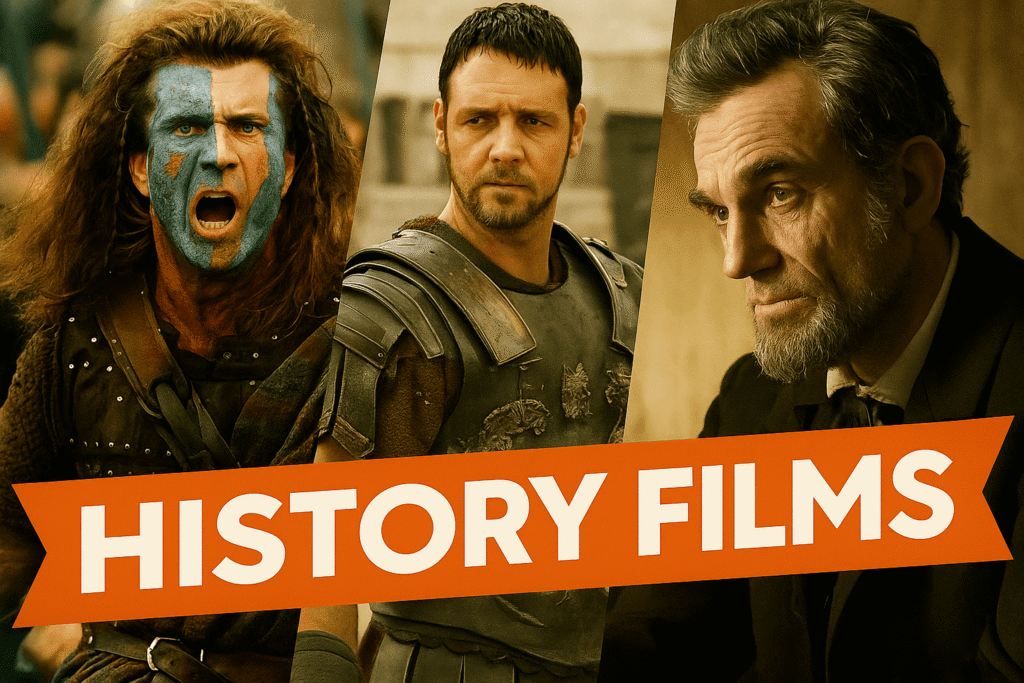
Ridley Scott’s Gladiator didn’t just tell the story of a Roman general turned slave turned hero — it reignited an entire genre. Set in ancient Rome, the film follows Maximus Decimus Meridius (Russell Crowe), a betrayed general seeking vengeance against the corrupt Emperor Commodus (Joaquin Phoenix).
From its breathtaking battle sequences to its sweeping score by Hans Zimmer, Gladiator delivers everything you want from a historical epic: scale, emotion, and unforgettable lines like “Are you not entertained?”
What Makes It Special
While many historical films drown in spectacle, Gladiator grounds its grandeur in deeply personal stakes. Maximus isn’t fighting for power — he’s fighting for justice, family, and honor. That emotional core is what made audiences connect so strongly.
The film also pushed the boundaries of visual storytelling, combining practical sets with early CGI to recreate the Colosseum in jaw-dropping detail. Its influence can be seen in every sword-and-sandal epic that followed, from 300 to Kingdom of Heaven.
3. Braveheart (1995)
Freedom, Fire, and Folklore
Before memes and catchphrases, Braveheart was the rallying cry for cinematic rebellion. Directed by and starring Mel Gibson, the film tells the story of Scottish warrior William Wallace, who leads his people in a fight for independence against English rule.
It’s loosely based on real events — but more importantly, it captures the spirit of resistance and sacrifice. The sweeping Scottish landscapes, passionate performances, and thunderous battle scenes make it one of the most emotionally charged films of its kind.
Why It Still Holds Power
Even though historians debate its accuracy, Braveheart nails what matters: the feeling of unity and defiance in the face of oppression. The speech before battle — “They may take our lives, but they’ll never take our freedom!” — remains one of the most iconic scenes in movie history.
It’s the kind of film that stirs something primal. Whether you’re Scottish or not, you can’t help but feel inspired. It’s history told with heart, fire, and cinematic flair.
4. 12 Years a Slave (2013)
A Story America Needed to See
Steve McQueen’s 12 Years a Slave is one of the most unflinching depictions of slavery ever put to film. Based on the true story of Solomon Northup — a free Black man kidnapped and sold into slavery in the 1840s — the film refuses to look away from the brutality of the era.
Chiwetel Ejiofor’s performance as Northup is hauntingly dignified, portraying not just suffering but endurance. Lupita Nyong’o delivers a heartbreaking performance that earned her an Academy Award, while Michael Fassbender embodies the cruelty of the system with disturbing realism.
Why It Matters
Unlike many Hollywood historical dramas that soften their edges, 12 Years a Slave forces audiences to reckon with the reality of its subject. McQueen’s direction is deliberate and patient, giving moments of pain the weight they deserve.
It’s not a movie you “enjoy” — it’s one you remember. It’s an essential work of historical storytelling, one that speaks to resilience, injustice, and the enduring fight for humanity.
5. Dunkirk (2017)
A War Film Unlike Any Other
Christopher Nolan’s Dunkirk isn’t just a World War II movie — it’s an experience. Told through three interwoven timelines (land, sea, and air), it recreates the 1940 evacuation of Allied soldiers from the beaches of northern France.
What makes Dunkirk remarkable is its approach. There’s almost no backstory, no traditional character arcs, and very little dialogue. Instead, Nolan uses sound, time, and perspective to immerse the viewer completely in the chaos of war.
The Art of Tension
Every minute of Dunkirk feels like a heartbeat. Hans Zimmer’s ticking score, paired with Nolan’s signature nonlinear storytelling, creates relentless tension. Instead of focusing on heroism in the traditional sense, the film celebrates survival — the quiet bravery of ordinary people under extraordinary pressure.
Visually stunning and emotionally raw, Dunkirk strips away sentimentality to reveal the essence of human endurance. It’s proof that history doesn’t always need words — sometimes, it just needs silence and courage.
What Makes a Great History Movie
So what separates the truly great historical films from the merely good ones? It’s not just accuracy — it’s connection.
1. Emotional Truth Over Exact Detail
Even the most factually precise film falls flat if it doesn’t move the audience. The best historical movies focus on emotional honesty — capturing what it felt like to live in that moment, not just what happened.
2. Realism Without Exploitation
A powerful historical movie shows pain and conflict without glorifying them. Schindler’s List and 12 Years a Slave are perfect examples: unflinching, but never manipulative.
3. Scope and Vision
From the mud and sweat of Gladiator’s arenas to the vast beaches of Dunkirk, great history films transport you fully. Every detail — costume, lighting, sound — works together to create immersion.
4. Humanity at the Core
History isn’t about dates or battles; it’s about people. When films focus on personal stories within grand events, they resonate more deeply. You remember Maximus’s grief, Wallace’s defiance, or Solomon’s strength — not just the wars they fought.