
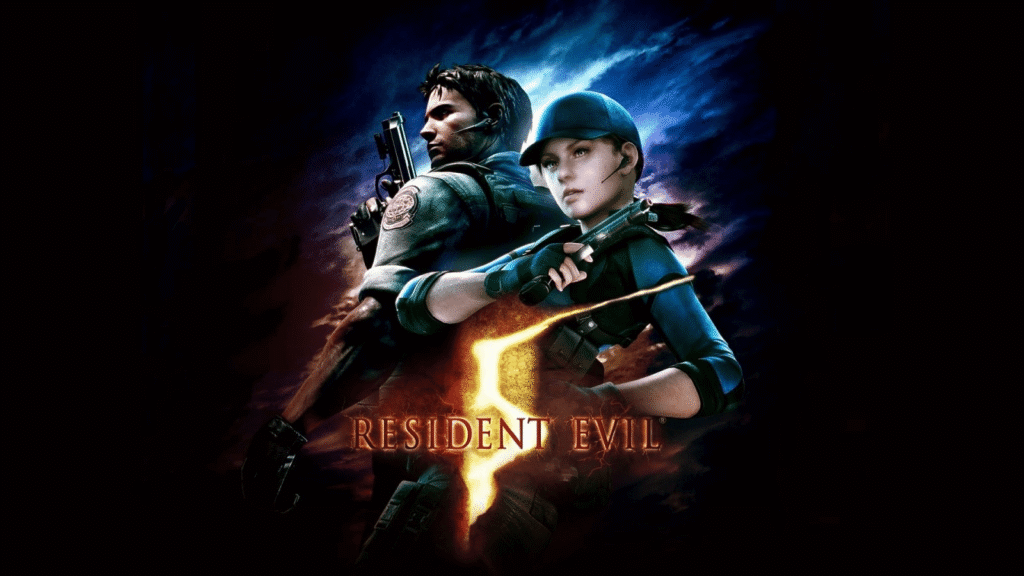
When Resident Evil 5 launched in 2009, it wasn’t just another entry in Capcom’s legendary survival horror franchise — it was a bold experiment. Following the massive success of Resident Evil 4, fans had sky-high expectations. The result was a game that pushed the series in a new direction: more action-packed, more cinematic, and built around teamwork.
Set under the blazing African sun, Resident Evil 5 fused horror with high-octane co-op gameplay in a way no other entry had attempted. While some purists missed the slow-burn tension of earlier titles, others discovered an intense, adrenaline-fueled adventure that worked beautifully when played with a friend.
More than a decade later, Resident Evil 5 still stands as one of the franchise’s most ambitious experiments — a turning point that redefined what Resident Evil could be.
Setting the Stage: From Raccoon City to Kijuju
A New Kind of Horror
Unlike the shadowy mansions and dark alleys of earlier games, Resident Evil 5 takes place in the fictional African region of Kijuju, a vibrant but chaotic area ravaged by a viral outbreak. Gone are the dim corridors and flickering lights — instead, players face daylight horror, where danger lurks in plain sight.
This shift in setting changed the tone entirely. Sunlight doesn’t make you feel safe; it just exposes more chaos. Swarms of infected locals, known as Majini, replace the traditional zombies, and their aggressive behavior turns every encounter into a fight for survival. The game’s open areas, crumbling towns, and industrial zones reflect a world falling apart — a striking evolution from the isolated environments of earlier titles.
Chris Redfield Returns — With a Partner
The story follows Chris Redfield, a veteran agent of the Bioterrorism Security Assessment Alliance (BSAA). Years after his run-in with Umbrella Corporation, he’s sent to investigate reports of a new bio-organic threat in Africa. There, he’s paired with Sheva Alomar, a fellow BSAA operative and local expert.
Together, they uncover a conspiracy tied to biological experiments, old enemies, and the resurfacing of the deadly Uroboros Virus — a sinister creation with roots in the Umbrella legacy.
What truly sets Resident Evil 5 apart, however, isn’t just its story — it’s the partnership between Chris and Sheva. For the first time in the main series, co-op wasn’t just a mode; it was the backbone of the entire experience.
Gameplay: Action, Strategy, and Survival in Tandem
The Co‑Op Revolution
Resident Evil 5 was one of the first major AAA games to make co-op gameplay central to its design. Players could team up locally or online, controlling Chris and Sheva as they battled through hordes of infected, solved puzzles, and shared resources.
The dynamic between the two characters added a layer of strategy — managing ammo, healing items, and weapon upgrades became a shared responsibility. You could hand over extra bullets to your partner or call for a quick assist when cornered by enemies.
Playing solo meant Sheva was controlled by AI, and while she held her own, the game truly came alive with a second human player. The teamwork element transformed the usual sense of isolation into tense camaraderie — two survivors depending on each other to stay alive.
Combat Evolution: Faster, Sharper, More Intense
Building on Resident Evil 4’s revolutionary over-the-shoulder camera, Resident Evil 5 refined the system for faster, more action-oriented gameplay. While players still couldn’t move and shoot at the same time (a series staple at the time), the gunplay felt punchier, and melee attacks added satisfying impact.
Enemies weren’t slow-moving zombies anymore — they sprinted, flanked, and attacked in groups. Some wielded weapons, others mutated into monstrous forms mid-battle. This forced players to think tactically, use the environment, and rely on each other to survive.
Weapons could be upgraded using gold and treasures collected throughout the game, encouraging exploration between firefights. Whether you preferred the precision of a rifle or the raw power of a shotgun, there was always a sense of progression and customization that kept the combat fresh.
Puzzles and Exploration
Despite its action-heavy focus, Resident Evil 5 didn’t abandon its puzzle roots entirely. You’ll still find moments of quiet exploration — ancient ruins hiding traps, cryptic mechanisms, and environmental puzzles that require teamwork to solve. These sequences serve as a breather between the intense combat, grounding the game in its Resident Evil heritage.
Some puzzles even require players to split up — one character operating levers while the other covers from afar — creating both tension and cooperation in equal measure.
Enemies and Boss Fights: Horror in the Heat
The Majini: Smarter, Meaner, Deadlier
The infected enemies in Resident Evil 5, called Majini, represent a significant shift from traditional zombies. Infected by the Las Plagas parasite (the same biological agent from Resident Evil 4), these creatures retain some intelligence. They coordinate attacks, use weapons, and swarm players relentlessly.
This makes encounters unpredictable. You’re not fighting mindless monsters — you’re battling organized aggression. Combined with the heat of the African setting, it adds a layer of suffocating intensity rarely seen in horror games at the time.
Iconic Boss Battles
Capcom has always excelled at designing unforgettable boss fights, and Resident Evil 5 delivers some of the best in the franchise. From the hulking executioner wielding a massive axe to grotesque, multi-phase monsters like Uroboros Aheri, every encounter feels cinematic and larger than life.
And then there’s Albert Wesker, the long-time series antagonist, who returns for one final showdown. His superhuman speed, arrogant personality, and climactic volcano battle against Chris and Sheva remain one of gaming’s most memorable endings — complete with over-the-top drama and perfectly timed quick-time events.
The Story Beneath the Action
A Global Conspiracy Unfolds
Beneath all the explosions and shootouts, Resident Evil 5 continues the franchise’s intricate web of biological warfare and corporate corruption. The game delves deeper into Umbrella’s downfall and the shadow organizations that rose from its ashes.
Chris’s journey isn’t just about stopping a virus — it’s about confronting the legacy of bioterrorism and the toll it’s taken on his humanity. His quest to find former partner Jill Valentine, presumed dead, adds an emotional thread that humanizes the chaos.
By blending personal stakes with world-ending danger, Resident Evil 5 grounds its blockbuster energy in the kind of moral complexity that defines the series.
Sheva Alomar: An Underrated Hero
While Chris is the veteran, Sheva’s role shouldn’t be underestimated. As a newcomer, she brings balance to the story — offering insight into local struggles and moral clarity amidst global conflict. Her strength, intelligence, and compassion make her one of the most underrated characters in the series.
Sheva’s presence also represents a rare instance of diversity in a major game at the time. She’s portrayed as capable and brave, not merely a sidekick, making her a fan favorite and a key reason Resident Evil 5’s story holds up today.
Visuals and Atmosphere
The Power of the MT Framework Engine
Technically, Resident Evil 5 was stunning for its time. Built on Capcom’s MT Framework Engine, the game delivered crisp visuals, dynamic lighting, and incredibly detailed environments. The mix of dusty villages, dark laboratories, and ancient temples created a sense of scale and variety that kept players engaged from start to finish.
Even today, the remastered versions on modern platforms hold up surprisingly well. The vibrant colors and sharp textures make Resident Evil 5 one of the most visually striking entries in the franchise.
Music and Sound Design
The sound design plays a massive role in maintaining tension. The quiet hum of insects in the desert, the echo of distant footsteps, the pounding drums during combat — every sound enhances the atmosphere.
The orchestral score elevates key moments, blending African-inspired rhythms with cinematic cues. Whether it’s a boss fight or a silent corridor, the music adapts to the emotion of the moment perfectly.
Legacy: The Turning Point of Resident Evil
A Divisive But Important Entry
When Resident Evil 5 released, it divided fans. Some loved the co-op and high-energy action, while others missed the creeping dread of earlier games. But looking back, its influence is undeniable. It paved the way for later entries like Resident Evil 6 and even inspired modern reimaginings of co-op survival.
It also helped bring the series to mainstream audiences. With over 13 million copies sold, Resident Evil 5 remains one of Capcom’s best-selling titles ever — proof that the gamble on action-driven gameplay paid off.
How It Holds Up Today
Revisiting Resident Evil 5 now feels nostalgic but surprisingly fresh. The gameplay still holds up, especially when played with a partner. The pacing, boss design, and tension-filled encounters keep it fun, while the visuals — especially in the remastered editions — remain sharp.
It’s not perfect, but few games manage to balance teamwork, horror, and blockbuster spectacle as effectively. For players who love co-op adventures with real stakes, Resident Evil 5 is still a must-play.